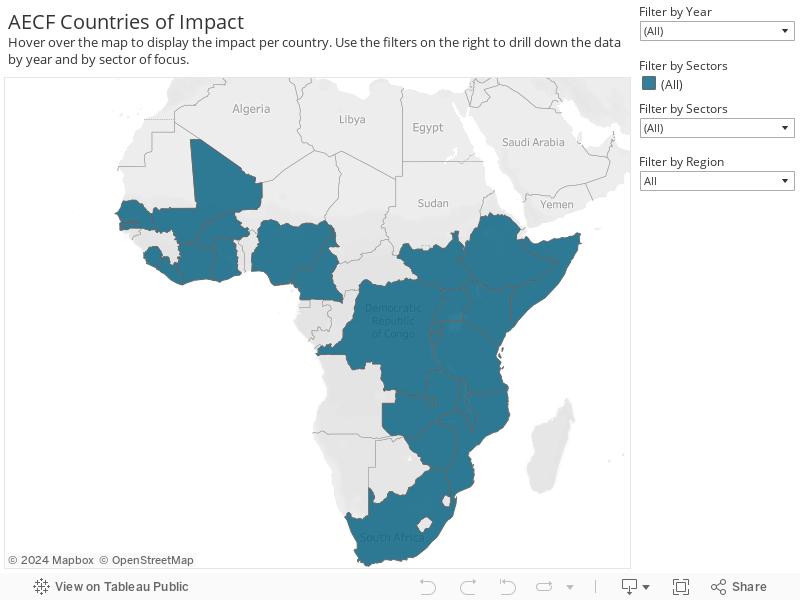


What is a Challenge Fund? Challenge funds are a mechanism for allocating and disbursing public funds efficiently and fairly. Organizations are invited to bid for scarce resources, not unlike a tender but where what counts is the quality of the response, not price. Rules are set and publicized, covering eligibility, the bidding process and the way that bids will be evaluated. Two separate bodies administer the process and decide on who gets an award, to avoid possible conflict of interest. The intention is to get funds to the organizations that truly need them and can use them effectively to realize the broader aims of public policy; and to do this transparently. In the case of AECF the overall policy aim is to promote new ideas that will lead to growth in the rural economies of Africa, generating employment and creating new opportunities for systemic change in the markets that serve them. How does the Africa Enterprise Challenge Fund work? The rules, management structure and processes referred to above are all set out on this website. The AECF is a competition, open only to for-profit private companies which are starting, or intend to start, new ventures in specific fields. Companies are invited to submit proposals outlining their business idea or concept for funding. What does the AECF offer? AECF offers Funding Windows targeted at specific economic sectors (including research-based agribusiness, renewable energy and rural financial services), at specific countries (including Zimbabwe and Tanzania) or at development corridors involving several countries. These windows are expected to open, one by one, over the course of 2010. Others may be added and each window will generally offer more than one Funding Round for additional new applications. It is not a once-only opportunity, see Funding Windows What ideas is AECF prepared to support? Each window has a special focus but the overall field is the set of value chains linking rural areas to their local and international markets, in services as well as goods. Winning business ideas will have a positive impact on the rural poor in Africa, delivering increased employment and income, reduced costs, and/or improved productivity. The competition rules favour ideas that promise profitable sustainability and provide evidence that the companies involved have the technical and financial capacity to deliver. They will be innovative. They will have to make a convincing case for the need for AECF funding, answering the question, “why couldn’t you do this with normal commercial finance?” What amounts of money are involved? The maximum amount the AECF can award to a single business idea is US$ 1.5m and the minimum is US$ 250,000. The average amount is expected to be around US$ 750,000. What is the AECF’s track record? The first competition was launched in mid-2008 and the fund will run a number of competitions each year for 6 years. By the end of 2009 AECF had completed four rounds of its standard competition, targeting agribusiness and rural financial services, across the continent. The last of these included AECF’s first special window for Fragile States which encouraged enterprise in countries emerging from conflict, with slightly easier terms than the main competition. The end of 2009 also saw the launch of the first country-specific round, also targeted at agri-business, rural financial services and the value chain, in Zimbabwe. Early 2010 saw the launch of the Research Into Business (RIB) window, aimed at commercialising agricultural research. In the first seven rounds 3,124 registrations of interest resulted in 1,440 complete applications. The Fund Manager shortlisted 232 of these for consideration by the Investment Committee, who approved 105 of these concepts to proceed to the full business planning stage. 39 enterprises emerged as winners (not including RIB, which is still in process), with AECF committing funding totaling US$ 31.7 million, split 49% Grant, 51% Repayable Grant. All the terms underlined have specific meanings in the AECF context, explained on the Proposal Process and About AECF pages. Past winners are shown on the Projects page.
|